Ricky Walden Survives Chaos to Beat Ding Junhui 5-4
Walden recovered from 4-3 down, survived a remarkable exchange of errors and finished the deciding frame with 69 unanswered points.
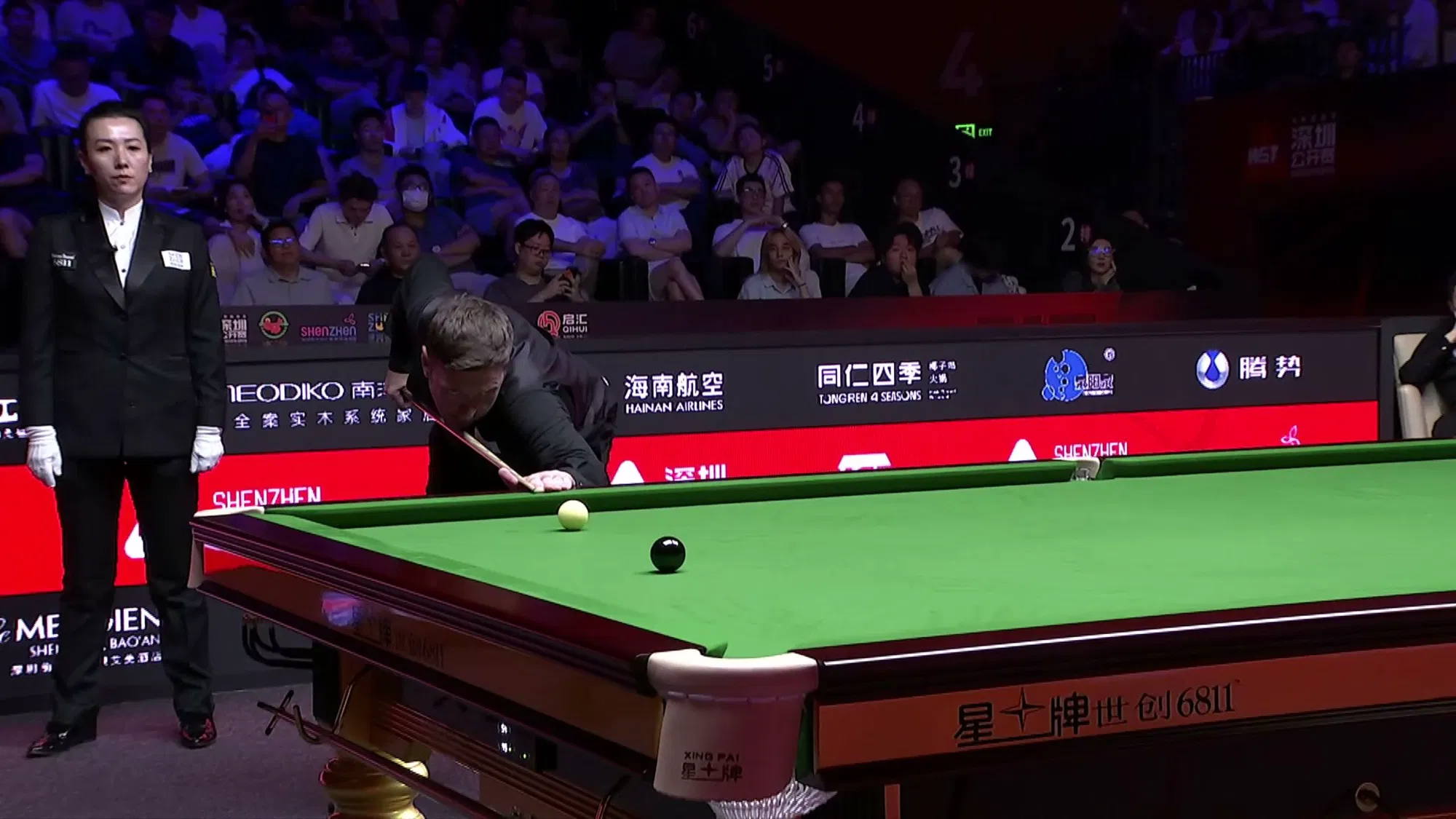
Ricky Walden defeated Ding Junhui 5-4 at the 2026 Shenzhen Open, recovering from 4-3 down to silence the home crowd and book a meeting with Ali Carter. Two century breaks powered Walden's mid-match surge, but the contest ultimately turned on an error-filled eighth frame and a decisive 69-point run in the ninth.
How did Ricky Walden beat Ding Junhui at the Shenzhen Open?
Ding made the stronger start at the Shenzhen Bao'an Sports Centre and moved two frames clear. Walden answered by winning three consecutive frames, building two centuries during that spell to turn a 0-2 deficit into a 3-2 lead.
The momentum shifted again when Ding claimed the next two frames. At 4-3, China's leading player was one frame from advancing and Walden had no margin for another mistake.
Walden survived a tense eighth frame 68-63 before taking control of the decider. A run of 69 unanswered points completed the comeback and gave the Englishman a 5-4 victory.
| Match stage | Scoreline | Key development |
|---|---|---|
| Opening phase | Ding led 2-0 | Ding controlled the early exchanges |
| Middle phase | Walden led 3-2 | Walden won three straight frames with two centuries |
| Ding's response | Ding led 4-3 | Two consecutive frames put Ding one from victory |
| Eighth frame | 4-4 | Walden edged a 68-63 tactical battle |
| Deciding frame | Walden won 5-4 | A 69-point run carried Walden into the next round |
The scoreline reflects how evenly the match was balanced. Ding won two separate clusters of frames, while Walden produced the more concentrated scoring burst and handled the final pressure better.
What happened during the chaotic eighth frame?
The eighth frame began with the scores level at 0-0 and quickly produced the match's most unusual exchange. Ding attempted an ambitious double from the left cushion, but the red stayed out and backspin carried the cue ball into a pocket.
The in-off presented Walden with an inviting opening red and an immediate chance to punish the error. Instead, he missed a routine pot, catching the jaws and leaving the table before he had scored.
The back-to-back mistakes were striking because both players had already demonstrated high-level break-building. Walden had compiled two centuries, while Ding had recovered from 3-2 down to stand one frame from victory. Pressure, not a lack of technical quality, shaped the exchange.
Walden eventually won the frame 68-63. That five-point margin mattered far more than the style of the snooker: it erased Ding's lead, forced a deciding frame and transferred the immediate pressure back to the home favorite.
Why was Walden's deciding-frame response so important?
Walden's 69 unanswered points in the ninth frame provided the clean finish that the eighth frame lacked. After a tactical and error-heavy battle, he found enough control to build a match-winning advantage when the opportunity arrived.
Short-format snooker often rewards the player who resets fastest after a difficult frame. Walden did exactly that. He did not carry the tension or missed red from the eighth into the decider, and Ding was never able to create another recovery.
The performance also showed two different sides of Walden's game. His two centuries demonstrated fluent scoring, while the narrow eighth-frame win showed that he could survive when the match became fragmented and uncomfortable.
What does the defeat mean for Ding Junhui?
Ding's exit will disappoint a Shenzhen crowd that watched him move within one frame of victory. The result also continues his wait for another ranking title after winning the 2024 International Championship.
There were still positive signs in the performance. Ding recovered after Walden's three-frame burst, reclaimed the lead at 4-3 and remained competitive through a demanding eighth frame. His run to the English Open semi-finals earlier in September also suggests that his overall form is stronger than this early exit alone indicates.
The concern is conversion. Ding had both a 2-0 advantage and a 4-3 lead but could not close the match. Against a player capable of consecutive centuries, leaving one final route back into the contest carried a heavy price.
Ding was not the only major name eliminated early in Shenzhen. Zhao Xintong, Mark Williams, John Higgins and Ronnie O'Sullivan also failed to reach the later stages, reshaping the draw before the tournament had fully settled.
Who will Ricky Walden play next?
Walden's next opponent is Ali Carter. The matchup gives Walden another experienced English opponent immediately after a match that demanded both scoring power and patience.
Carter is known for disciplined match play and will test whether Walden can reproduce the scoring rhythm that generated two centuries against Ding. Walden will also want to avoid the loose positional and potting errors that made the eighth frame unnecessarily dangerous.
The 5-4 victory gives Walden more than a place in the next round. He has already won a close match against a leading Chinese player in front of a partisan crowd, recovered twice from scoreboard pressure and finished decisively when the match reached its final frame.
What was the final score between Ding Junhui and Ricky Walden?
Ricky Walden beat Ding Junhui 5-4 at the 2026 Shenzhen Open.
How many century breaks did Ricky Walden make?
Walden made two century breaks while winning three consecutive frames to move from 0-2 down to 3-2 ahead.
What happened in the eighth frame?
Ding went in-off while attempting a double, then Walden immediately missed a routine red. Walden recovered to win the frame 68-63.
Who does Ricky Walden play next?
Walden advances to face Ali Carter in the next round of the Shenzhen Open.