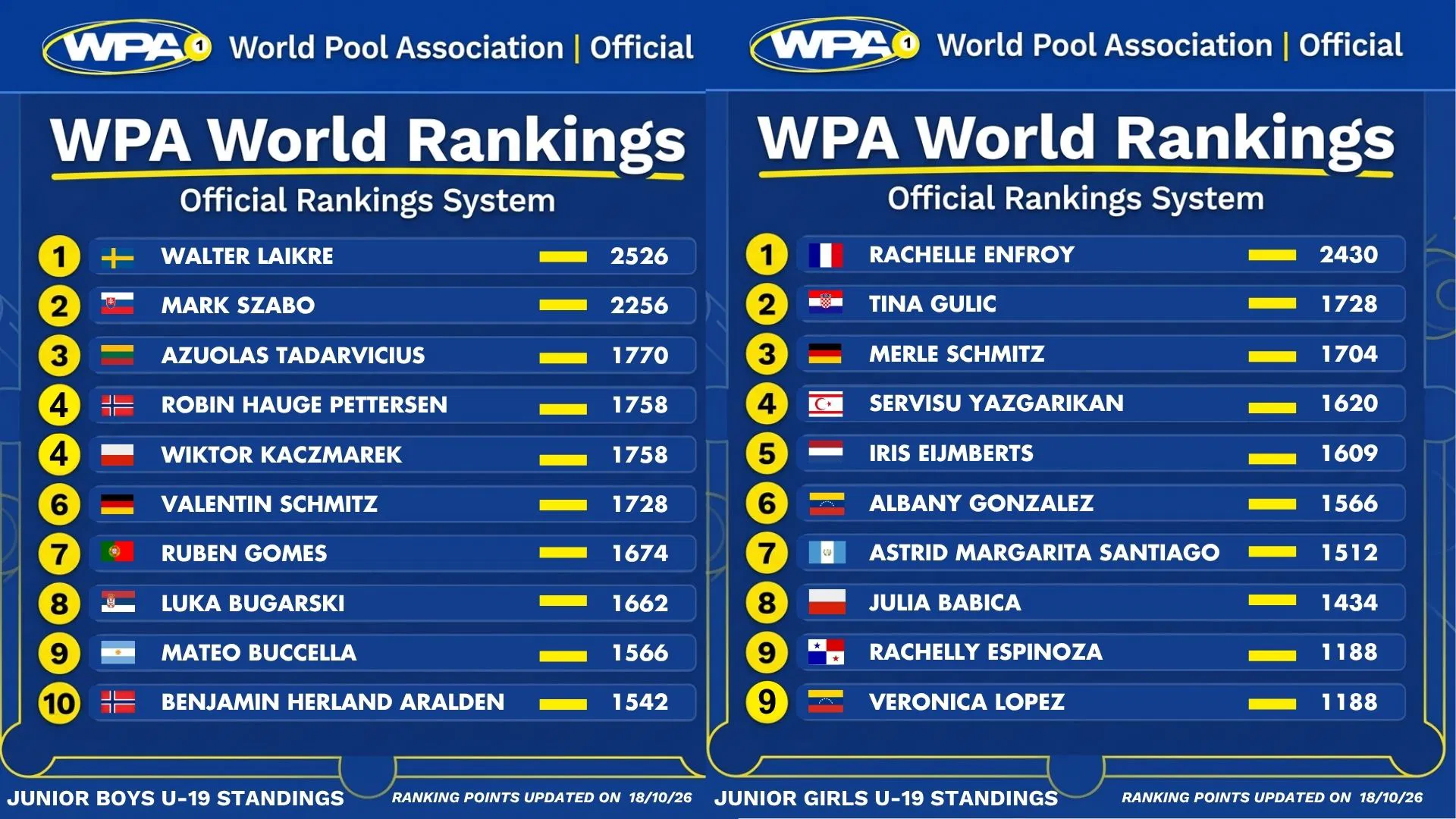
The World Pool Association's first unified junior rankings place U17 and U19 results into one boys' table and one girls' table. Sweden's Walter Laikre leads the boys with 2,526 points, while France's Rachelle Enfroy heads the girls with 2,430.
The new system gives junior pool a shared international reference across several disciplines. It also comes with an important caveat: these standings measure a mix of age groups, games and sanctioned events rather than performance in one format alone.
Who leads the first WPA junior rankings?
Laikre holds a 270-point advantage over Slovakia's Mark Szabo in the boys' standings. Lithuania's Azuolas Tadarvicius sits third on 1,770 points.
Enfroy has a wider lead in the girls' table. Her 2,430 points put her 702 ahead of Croatia's Tina Gulic, with Germany's Merle Schmitz another 24 points behind in third.
| Boys' rank | Player | Country | Points |
|---|---|---|---|
| 1 | Walter Laikre | Sweden | 2,526 |
| 2 | Mark Szabo | Slovakia | 2,256 |
| 3 | Azuolas Tadarvicius | Lithuania | 1,770 |
| Girls' rank | Player | Country | Points |
|---|---|---|---|
| 1 | Rachelle Enfroy | France | 2,430 |
| 2 | Tina Gulic | Croatia | 1,728 |
| 3 | Merle Schmitz | Germany | 1,704 |
The published points accompanying the launch were updated on October 18, 2026. Rankings can change as new sanctioned results are added, so the date matters when comparing positions.
Why did the WPA combine U17 and U19 players?
Junior players have fewer ranking tournaments than the established men's and women's categories. A separate table for every age group and discipline would therefore rely on a smaller set of results.
The WPA chose a broader model. U17 and U19 athletes compete for position in the same gender-based standings, giving the rankings more events, more countries and a larger group of players to measure.
That makes the table easier to follow. It also means age remains useful context. A younger player may be competing against athletes with more international experience, even though both appear in the same list.
Which pool disciplines count toward the rankings?
The ranking system draws from WPA-sanctioned junior competition across 8-Ball, 9-Ball, 10-Ball and Straight Pool. Heyball and Blackball results are included as well.
| Result source | Included in the system? |
|---|---|
| Continental championships | Yes |
| World championships | Yes |
| Other WPA-sanctioned junior events | Yes |
| 8-Ball, 9-Ball and 10-Ball | Yes |
| Straight Pool | Yes |
| Heyball and Blackball | Yes |
This wide mix rewards players who compete across the international junior calendar. It doesn't automatically identify the best specialist in one game. A player could rank highly through points earned in several disciplines, while another may be stronger in a single format but have fewer eligible results.
What do the point gaps reveal?
Laikre's 270-point margin over Szabo is meaningful, but the boys' table tightens quickly below second place. Tadarvicius is 486 points behind Szabo, and the official graphic shows several players grouped closely behind third.
The girls' standings have a clearer leader. Enfroy's 702-point advantage over Gulic is nearly three times the size of Laikre's lead in the boys' table. Second and third are separated by just 24 points, however, so one strong sanctioned result could alter that order.
These gaps are a snapshot, not a forecast. Point totals depend on the events available, the disciplines played and each athlete's ability to travel to international competition.
Why do junior world rankings matter?
A global ranking gives young players something more precise than a collection of isolated tournament finishes. It shows where results sit within a wider international field and gives federations a way to track progress over time.
Visibility matters too. Junior competitions often receive less coverage than professional events. A published table puts player names, countries and point totals in one place, making strong seasons easier for fans, coaches and national bodies to recognize.
The rankings also show the geographic spread of youth pool. The first three positions in each table are occupied by players from six different European countries: Sweden, Slovakia, Lithuania, France, Croatia and Germany.
What are the limits of the current system?
The first version trades detail for coverage. Combining age groups creates a fuller table, but it doesn't separate U17 development from U19 performance. Combining disciplines has the same effect: it shows overall sanctioned results rather than game-specific strength.
Tournament access is another factor. Two equally skilled players may have very different point totals if one can enter more continental and world events. The rankings measure recorded results, not every part of a player's ability.
The WPA has said the system will be reviewed as participation and the junior calendar grow. Separate discipline rankings could be considered later if enough competition exists to support them.
What should fans watch next?
The most useful signal will be movement over several updates. A single table identifies the early leaders; repeated updates will show who can collect points across seasons and who rises when new events enter the calculation.
Watch the players clustered around second and third. Szabo is close enough to challenge Laikre with a strong run, while the 24-point gap between Gulic and Schmitz makes the girls' second-place race especially tight.
The rankings are still young. Their value will grow as the calendar expands and more athletes build complete international records.
Who is No. 1 in the WPA Junior Boys ranking?
Walter Laikre of Sweden leads with 2,526 points in the standings published with the launch.
Who leads the WPA Junior Girls ranking?
Rachelle Enfroy of France is first with 2,430 points.
Are U17 and U19 players ranked separately?
No. The current system combines U17 and U19 athletes into one boys' ranking and one girls' ranking.
Which games count toward the junior rankings?
The system includes 8-Ball, 9-Ball, 10-Ball, Straight Pool, Heyball and Blackball results from eligible events.
Could the WPA create separate discipline rankings later?
Yes. The WPA may consider discipline-specific rankings as participation and the international junior calendar expand.